Screen printing for bulk T-shirt orders: when it's worth it
Apex Print Studio · · 5 min read
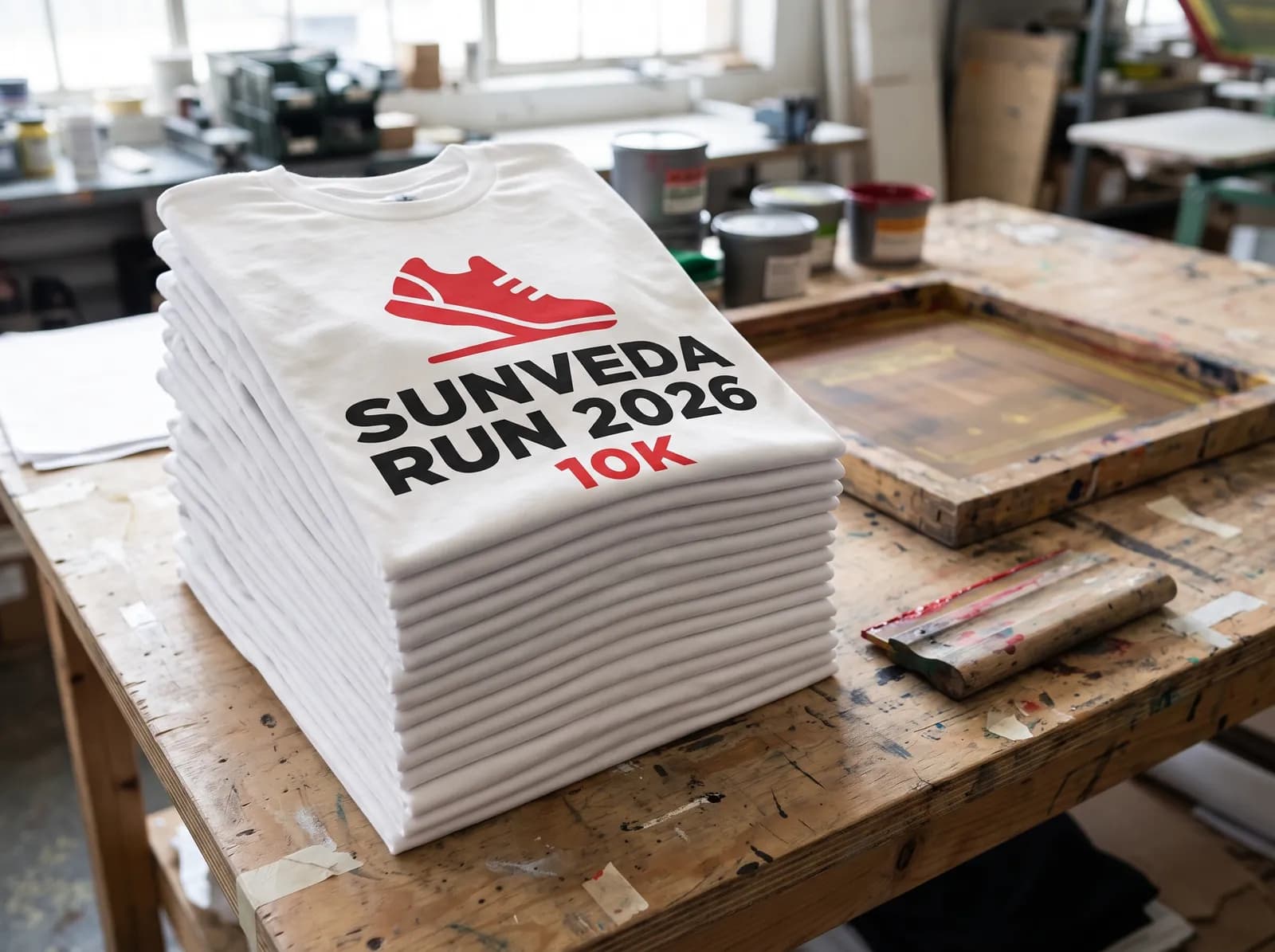 Sample design
If you need a lot of t-shirts with the same design (for a run, a college fest, a company event or a campaign), screen printing is often the most economical way to get them. It's the classic bulk method: bold, bright and very durable. But it isn't right for every design. Here's how it works and when to choose it.
How screen printing works
- Screens: a fine mesh screen is made for each colour in your design.
- Printing: ink is pushed through the screen onto the garment, one colour at a time, lined up precisely.
- Curing: the print is heat-cured so the ink bonds with the fabric and survives washing.
Making the screens is the set-up work. Once they're ready, every extra piece is quick to print, so the price per piece drops as the quantity goes up. That's why we screen print from 50 pieces per design.
When screen printing is the right choice
- 50 or more pieces of one design. The more pieces, the better the value.
- A design with one to four solid colours. Logos, slogans, event names and simple illustrations are ideal.
- You want bold, durable colour. Screen-printed ink is thick and bright, and it lasts wash after wash.
When DTF is better
- Fewer than 50 pieces, or a single sample first.
- Photos, gradients or many colours. Each colour needs its own screen, so full-colour artwork is better printed with DTF.
- Different names or numbers on every piece. DTF can print every piece differently at no extra set-up cost.
You don't have to choose on your own: tell us your design and quantity, and we'll tell you which method works out better for your order.
Designing for screen printing
- Count your colours. One to four solid colours keeps the set-up simple. The garment colour can act as an extra colour for free.
- Use solid shapes and clear lines. Very thin lines and tiny text can fill in. Keep text large enough to read from a few steps away.
- Avoid soft gradients and photos. They need a different approach; DTF handles them better.
- Send vector artwork (PDF, AI, EPS or SVG) if you have it, so the colours can be separated cleanly. See how to prepare your artwork.
Planning a bulk order
- Fix the design first. Every design (and every colour change) needs its own screens, so finalise it before you collect sizes.
- Collect sizes with a simple sheet. The 50-piece minimum is per design, and it can be split across sizes.
- Add a few spares for late sign-ups and size swaps.
- Check the proof carefully. You get a free digital proof showing the colours, size and position before anything is printed.
Planning tees for a festival or a run? See the festival t-shirt planning guide, or send your design and quantity on WhatsApp or through the quote form. More about screen printing.
Common questions
What is the minimum order for screen printing?
We screen print from 50 pieces per design. Below that, DTF printing is usually the better choice, with no minimum order.
Is screen printing cheaper than DTF?
For 50 or more pieces of a simple design with one to four solid colours, screen printing usually costs less per piece. For full-colour artwork, photos, gradients or small quantities, DTF is usually cheaper.
Can I order different sizes in one screen printing order?
Yes. The minimum is per design, not per size, so 50 tees of one design can be split across sizes.
Does screen printing work on dark t-shirts?
Yes. Screen printing uses opaque inks that stay bright on black and dark garments, as well as on white and light colours.